For the past decade, I have been working towards a “self-hosted cloud” that will help me regain control of my data online. As someone who grew up with the Internet, I see value in keeping the web open and secure, as it was originally designed. However, that idea of a network filled with freely available information has been threatened by the existence of “the cloud”, a siloed store of information owned and operated by an organization, typically for profit.
Since the concept of the cloud was created, companies such as Amazon, Google, and Microsoft have created their own cloud platforms, allowing companies and individuals to buy storage, processing power, and network throughput from one of their datacenters. For a system administrator or developer, the cloud makes a very tempting offer. All hardware maintenance is covered by the cost of hosting, meaning you don’t need to worry about updating firmware or replacing hardware, since it’s all handled for you. On top of that, you only have to pay for what you use, meaning a switch to their serverless model will save you even more money. Serverless workloads allow your workflow to scale with the number of requests, since the hardware has been completely abstracted away, allowing customers to scale across multiple servers if necessary. Sounds great, right?
The Problems With the Cloud
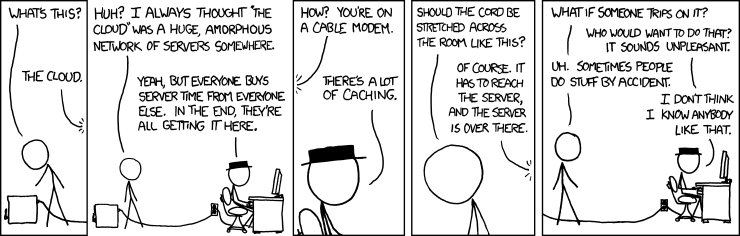
So far, I have been focusing on infrastructure as a service (IaaS), which is only a small part of what makes the cloud “the cloud”. Unless you are a developer or system administrator, you will likely never get to experience that side of the cloud. Instead, what most people get to experience today is software as a service (SaaS). The main audience for SaaS is non-technical, offering ready-made solutions for communication, entertainment, productivity, storage, and anything else you might be able to imagine. If this is the first time you’ve heard of this, you’ve almost certainly used SaaS products without even knowing it.
From here, the problems with the cloud vary based on the target market. Starting with SaaS for business, businesses are sold a product that is typically billed on a “per user per month” basis, although many will give discounts for paying for the entire year. Most SaaS products are built on top of cloud-based infrastructure, and some cloud providers offer their own SaaS solutions, such as Google Workspace and Microsoft 365. Just like the infrastructure part of the cloud, this allows businesses to scale with the number of employees, however this comes with several disadvantages. First, this requires businesses to convert their capital expenditures (CapEx) into operational expenditures (OpEx). What was once a one-time purchase for another copy of a particular software, has become a monthly, recurring payment to a cloud service for every single employee. That’s a tough sell for many companies, so customers are incentivized to switch to the cloud version, because the original version they’ve grown attached to will become unsupported, potentially disrupting business operations in the future. On top of that, this recurring stream of income stifles innovation, since software companies no longer have to convince customers to upgrade to the latest version to keep making money. If that wasn’t bad enough, the customer’s data is kept in the cloud as well, making it difficult, if not impossible to switch to a competitor’s product if such a need arises.

Switching gears, SaaS for personal use has a different target, since many personal SaaS products are offered for “free”. If you’ve ever signed up for a free account online, you’ve obviously read through the War-and-Peace-length terms and conditions that you said you did when you signed up… right? Realistically speaking, you haven’t read them at all, and gave them your information to make the account you needed to access whichever service you wanted to access. Congratulations, you are now the product they are selling! Everything you do with that account is being tracked, processed, and sold to their partners for background checks, scientific research, targeted advertising, and most recently, collecting training data for Large Language Models (LLMs), among other things. To make things even better, the data that is collected about you is occasionally compromised, due to no fault of your own, and exposed to an unauthorized party. From there, the data can be used against you, resulting in unwanted e-mails or phone calls, especially for the purposes of marketing or phishing. If you’re curious about what has been exposed about you so far, Have I Been Pwned is a good place to start. Just in case you wanted even more good news, many companies have started adding a forced arbitration clause to their terms and conditions, meaning you don’t even have the legal right to sue them if things get to that point.
Finally, I’m going to talk about IaaS again. I’ve already mentioned how the market for cloud-based infrastructure targets tech-savvy customers, who want to move their existing infrastructure to the cloud or even start their own SaaS, but there are problems at this level as well. First, administrators and developers often get locked into a particular cloud provider’s version of a serverless architecture. Moving from one cloud provider to another often means re-architecting an application to fit the services offered by the new provider. In other words, customers are financially incentivized to commit to a specific cloud provider. Amazon is a good example of how difficult it can be to switch away from something. Have a look at the list of products offered by Amazon Web Services, many of which do not have suitable alternatives elsewhere. Reliability is another concern when working with a cloud provider. Amazon’s infamous us-east-1 region has a nasty habit of failing and taking a good chunk of the Internet with it. This problem isn’t unique to Amazon, as other cloud providers like Microsoft have experienced similar problems. A single point of failure is still a single point of failure, regardless of where the servers live.
Conclusion

All of this is just scratching the surface, but I don’t want this entire series to be another person complaining about the current situation. Instead, I want to share what I’ve been doing to remove myself from the cloud, so others can follow in my footsteps, suggest better alternatives, and build community-centric servers that serve its members.
Cheers to a better Internet!